
The easiest way to understand pricing is to picture a job like a pie.
Let’s use a $10,000 HVAC installation as the example and break it down piece by piece.
Step 1: Start With the Full Job Price
You sell the job for $10,000.
That money doesn’t all go to the business.
It gets split up to pay for the job, run the business, and (hopefully) make a profit.
Step 2: Pay for the Job Itself (COGS – 55%)
The biggest slice of the pie is the cost to actually do the job.
That’s called COGS (Cost of Goods Sold).
In this example:
- 55% = $5,500
This pays for:
- Direct labour (installers and the sales effort to win the job)
- Materials, parts, and equipment
- Superannuation
- Performance or bonus pay
- Hire gear or machinery
- Subcontractors
- Any other direct cost needed to complete the job
👉 If the job runs over time or isn’t efficient, this slice grows — and something else shrinks (usually profit).
Step 3: What’s Left Is the Gross Margin (45%)
After paying the job costs, you’re left with:
- $10,000 – $5,500 = $4,500
This is called gross margin.
Think of this as the money left to:
- Run the business
- Make a profit
But this $4,500 still isn’t yours yet.
Step 4: Pay to Run the Business (Overhead – 35%)
Next, the business has to pay its ongoing costs.
In this example:
- 35% = $3,500
This covers things like:
- Office staff wages, payroll tax, and super
- Uniforms
- Fuel and tolls
- Phones, internet, and computers
- Insurance (workers comp, vehicles, business)
- Rent and electricity
- Vehicle finance and maintenance
- Tools and repairs
- Marketing and advertising (to win the job)
- Training and development
- Safety equipment
- Software and subscriptions (like brix)
- Warranty after care support
- All the everyday costs that keep the doors open
These costs exist whether you’re busy or quiet.
Step 5: What’s Left Is Your Profit (Net Margin – 10%)
After everything is paid, what’s left is:
- 10% = $1,000
This is the net margin.
It’s the actual profit.
This is what allows the business to:
- Grow
- Invest
- Replace vehicles
- Handle slow periods
- Reward the risk of running a business
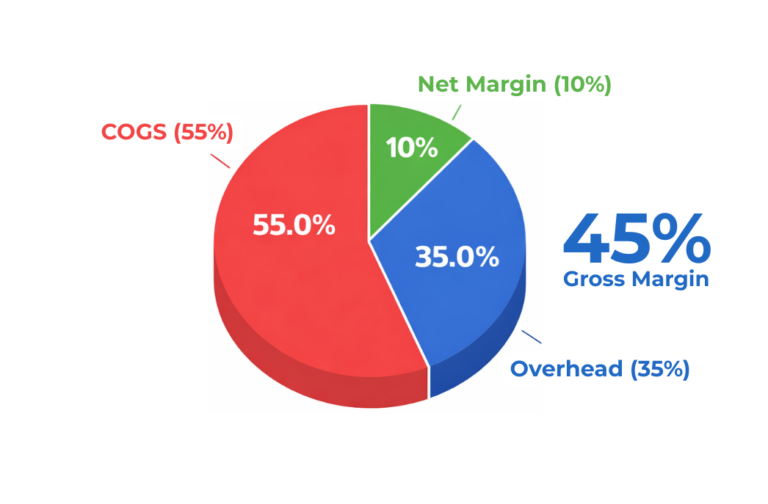
Cost Breakdown of an HVAC Install Job ($10,000)
Green net Margin 10% + Blue Overhead 35% = Gross Margin 45%
Putting It All Together (Simple Version)
Out of a $10,000 job:
- $5,500 pays for doing the job (COGS)
- $3,500 pays for running the business (Overhead)
- $1,000 is real profit (Net Margin)
The Simple Way to Think About It
- First, pay for labour, materials, and parts
- Then, pay for running the business
- Whatever is left is profit
If any part is under-allowed for, the business suffers — even when work is flowing.
Why This Breakdown Matters
When you understand where the money goes:
- You price jobs with confidence
- You avoid underquoting
- You protect profit
- You build a stronger business
This is exactly why brix shows pricing this way — so every job pulls its weight and the business can grow, not just stay busy.
Quick Summary
- $10,000 job
- COGS (55%): $5,500 to do the job
- Overhead (35%): $3,500 to run the business
- Net Profit (10%): $1,000 left over
Busy doesn’t always mean profitable.
Clear numbers do.
Build better. Price smarter. Grow with brix.